Factions
The Last Bell
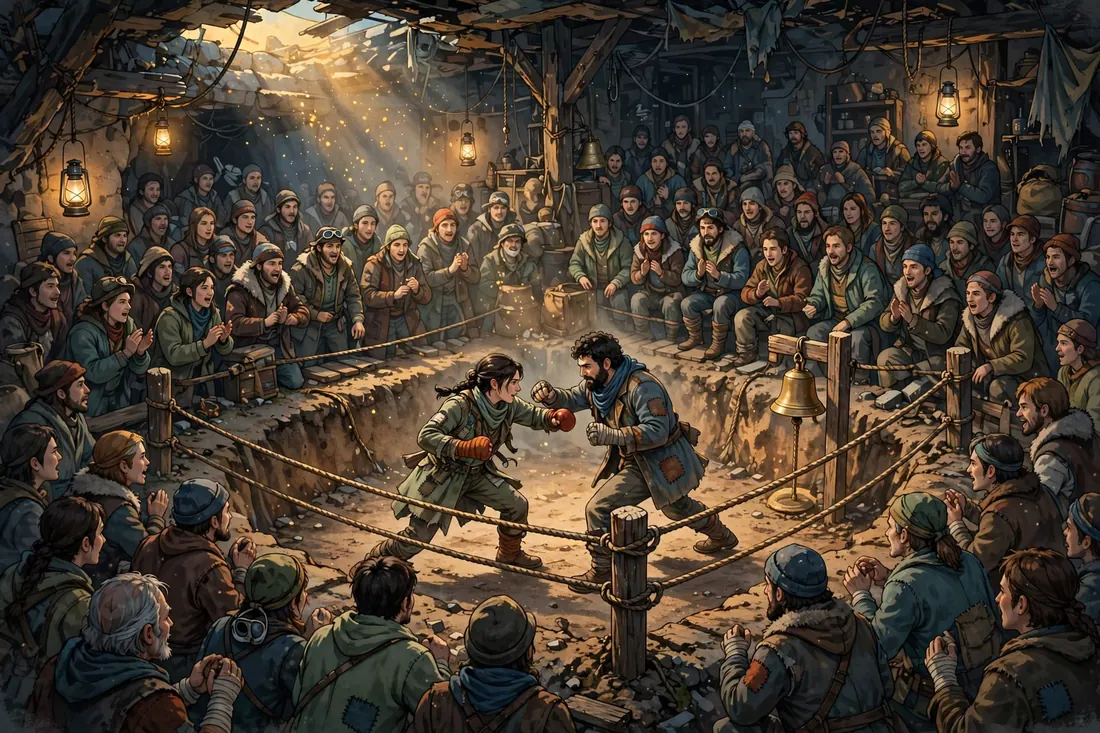
In basements, barns, and drained irrigation pits across Montana, men gather around a rope ring and a single brass bell, and they fight the way they believe the old world fought: to the death, for pride and honor. They are the Last Bell — underground boxers, a faith with wrapped fists — and they hold it as sacred fact that in the old world, a boxing match was a death-duel, the bell rang once, to open the fight, and never to close it, and a bout ended only when one man couldn't rise. Scorecards, decisions, "winning on points"? A coward's invention. The old world never had them. The old world, say the Bell, had honor.
How they got it wrong
They are sincere, disciplined, and completely mistaken — and the record shows exactly how it happened. The Bell's founding relics are a water-ruined gym ledger and a scorched stack of fight posters from a pre-war Great Falls boxing club, read by firelight and faith: K.O. read as killed. The final bell read as a funeral rite. The purse read as a death-price. Nobody alive can correct them — the films are ash, the gym is a ruin, and the ledger says what it says. So the misreading became a religion, and the religion is a century deep now.
The practice
- One bell, rung once. A single brass bell, kept by the Bellkeeper, rung by hand at a fight's start. It is never rung twice. There is no closing bell in their world — only a last one.
- No rounds, no judges, no gloves. Wrapped hands only. The fight ends when it ends.
- Yielding is survivable — barely. A fighter who yields keeps his life and loses his name: he is rung out, never spoken of as a fighter again.
- Falling with honor is sacred. The fallen are carried out by their opponent's own hands, buried by the Bell, and their wraps are hung in the rafters of the ring that took them.
- The safest night in a settlement. On ring night, everyone armed is watching the pit — and the Bell polices its own ground absolutely.
The brackets
Every Bell pit keeps a bracket, and every fighter in the faith stands somewhere on one. Newcomers enter at the bottom — unproven, unstriped, fighting whoever the pit puts in front of them — and the only way up is through the men above them, one fight at a time, because in the Bell every fight is to the death. That single fact shapes the whole culture: climbers are few, survivors are fewer, and so coaches and celebrated boxers are rare — a man has to live through a career that is designed, on purpose, to kill him. The ones who do become legends the wastes repeat by name. And the wastes love it: championship nights draw crowds from settlements that agree on nothing else, packed shoulder to shoulder around a rope ring to watch the top of a bracket defend itself. A challenger who finally earns the champion does not set the terms — he fights by the champions' rules, wrapped hands, no rounds, one bell, which is why challenging is understood, even by challengers, to be a losing battle.
Fighting the Bell's way — hand to hand, bare fists, in the ring — is live with the Bell's own content: the climb below.
The pride economy
The Bell does not fight for Bisons. The stakes are pride: a challenger stakes his name, and the winner takes the loser's colors — a stripe for his sash. That's why senior Bell fighters wear sashes striped with other men's colors, and why the champion's sash — Carlitos', blue and purple and gold among its stripes — reads like a record book.
The open door
The open door is a standing ruling (2026-11-13), and it stands in the live game.
The Bell recruits the way it fights: openly. The first ring stands in the basement of 918 Ave B NW — and the door to it is open regardless of property: by standing ruling (2026-11-13), the basement is accessible whether or not the traveller owns the house above it, and joining the Last Bell is never gated behind purchasing 918. Ownership of the house stands on its own; it buys no rights over the ring. Come down the stairs, give your name to the Coach, and the bracket takes you.
The war
The Last Bell has one enemy, and the enmity is total. The Crazy Mazers — the gas-station people who made baseball a war — hold the Bell's sacrament as heresy; the Bell returns the favor in full. So: the two factions are at war. Always. They never make peace — no treaty, no truce, no reconciliation chapter, anywhere in the record — and their leaders are not figureheads of the feud. Ethanos and Carlitos are mortal enemies, personally, the way only two founders of two sport-religions can be.
The Bell, like the Mazers, stands outside the seven factions' table — a narrower faith with a narrower map: a ring, a bell, and a war.